ProPR Expands With Webhooks, Multi-SCM Coverage, and Flexible AI Connections
- Meister Dev Team
- 23 Apr, 2026
The latest ProPR upgrade wave expands both ends of the review loop: where pull request events come from and which AI runtime can power them. Across recent changes, ProPR moved from an Azure DevOps-only operational model to a provider-aware review platform with explicit webhook support and flexible AI connection profiles.
This matters because the reviewer is no longer tied to a single SCM host or a single model backend. Teams can standardize the review experience across more repositories, more deployment topologies, and more AI governance requirements without losing the traceability and operational controls added in the previous release.
One Reviewer, More SCM Coverage
The first major shift is on the source-control side.
- Azure DevOps remains supported, but it is now joined by GitHub, GitLab, and Forgejo-family providers.
- Provider connections separate credentials, scopes, and reviewer identity so each client can be configured explicitly instead of relying on one global integration path.
- Mixed-provider operations now have clearer readiness and status boundaries in the admin experience, which is important for agencies and platform teams running more than one client or host family.
That gives ProPR a broader operating surface without changing the review goal. The same reviewer can inspect changed files, reason across related context, and publish findings back into the review thread where developers already work.
Webhooks That Fit Real Deployments
The second shift is how reviews get activated.
- ProPR now supports provider webhook flows in addition to background discovery.
- Webhook configuration and delivery history make event-driven automation easier to inspect when something fails or needs to be retried.
MEISTER_PUBLIC_BASE_URLlets generated listener URLs resolve correctly when ProPR sits behind a reverse proxy or public ingress.
This closes a practical deployment gap. Teams that prefer event-driven review intake no longer need to choose between webhook automation and a clean reverse-proxy setup.
AI Connections Built For Review, Memory, And Embeddings
The latest follow-up work expands the AI side in the same provider-neutral direction.
- Each client can now define AI connection profiles instead of treating model access like a single backend setting.
- Azure OpenAI, OpenAI, and LiteLLM are supported today.
- Purpose bindings let teams assign different models to review, memory reconsideration, and embedding workloads, with optional effort-specific review overrides when they need them.
That means teams can tune for different constraints without compromising the product architecture. Review quality, memory behavior, and embedding cost no longer have to share one blunt configuration.
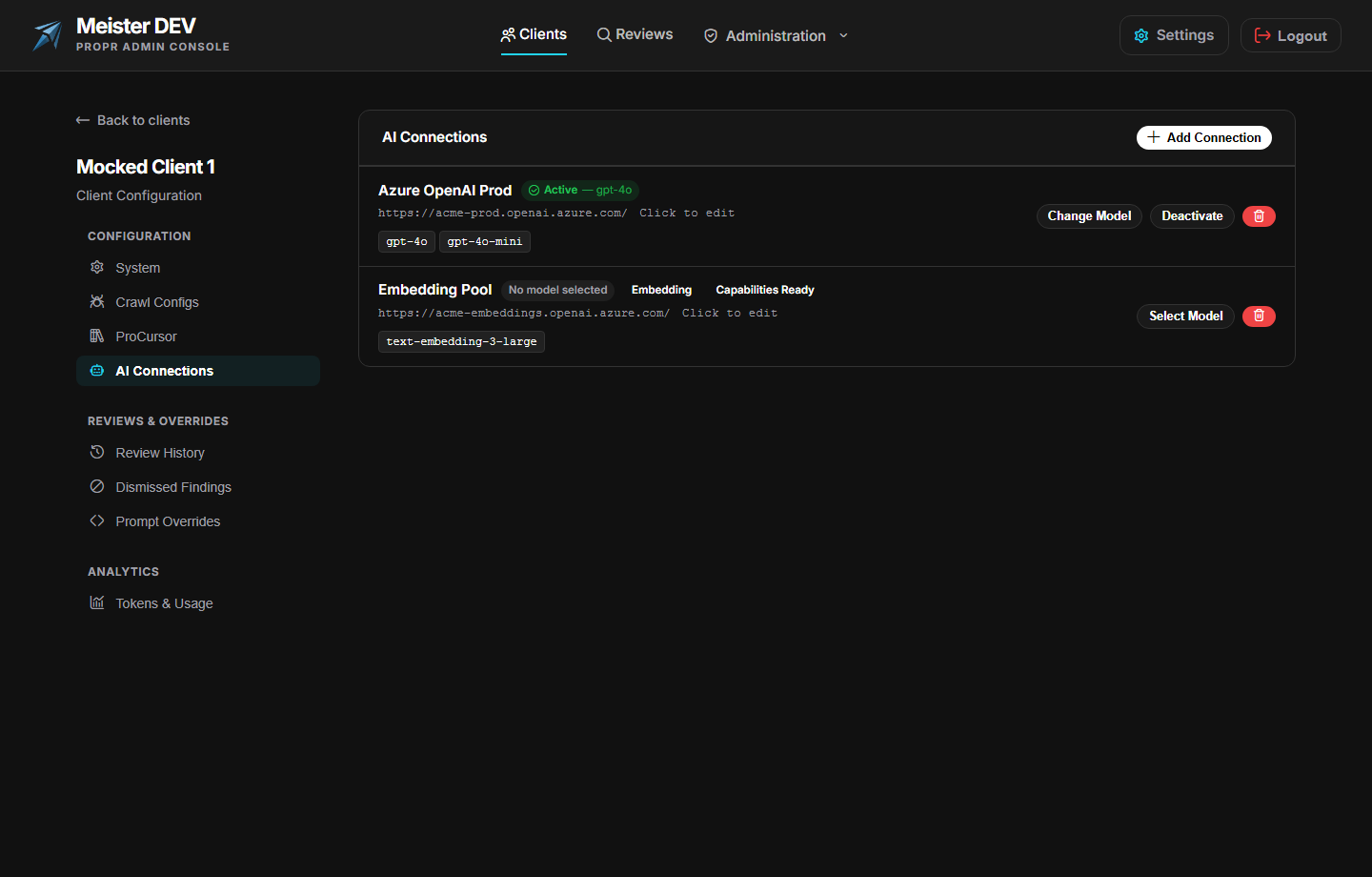
AI Connections lets each client configure provider profiles and separate model bindings for review and embedding workloads.
What Changes For Teams
Taken together, these upgrades make ProPR easier to roll out in real environments:
- More SCM coverage means one review product can span Azure DevOps, GitHub, GitLab, and Forgejo-family repositories.
- Webhook support means review automation can react to provider events instead of depending only on crawlers.
- Flexible AI profiles mean teams can align model choice with latency, cost, compliance, or hosting constraints.
Info
Operator note. If ProPR is deployed behind a reverse proxy, set MEISTER_PUBLIC_BASE_URL so generated webhook listener URLs point to the externally reachable host. After upgrading, review provider connections and AI profiles per client before enabling automated review flows in production.
If you want the product-level walkthrough, the ProPR page now reflects the broader SCM and AI provider support directly. If you want the implementation detail, the GitHub releases and current documentation show the underlying configuration model in more depth.